Here is a calendar and index of IS posts, for those who wish to tackle the novel in the summers to come.
Blog
-
Acknowledgements
Back in April, when I set out to recruit three more Guides, I decided to start with the folks I thought would be best suited for the role and then move down the list as I accumulated rejections (of which I expected plenty). Instead, to my great fortune, the first three people I asked accepted. I’m a little unclear on how that happened, but I could not be more appreciative.
The Guides agreed to do all they did this summer on a volunteer basis. If you believe that awesome and generous people deserve reward, please support them in their current and future endeavors.
Eden M. Kennedy’s most recent project is Let’s Panic About Babies (co-authored by Alice Bradley), and was called “a hilarious Onion-style website about parenting” by Redbook magazine. Eden also writes yogabeans! (where her son’s action figures demonstrate the intricacies of ashtanga yoga) and Fussy (where she writes angry open letters to Justin Timberlake and chronicles her daily life).
Kevin Guilfoile’s bestselling debut novel Cast of Shadows–called “gripping” by the New York Times and one of the Best Books of 2005 by the Chicago Tribune and Kansas City Star–has been translated into more than 15 languages. He was the co-author (with John Warner) and illustrator of the #1 bestseller My First Presidentiary: A Scrapbook by George W. Bush. Kevin is a co-founder and commissioner of The Morning News Tournament of Books, and his essays have appeared in The New York Times Magazine, The New Republic, Salon, and McSweeney’s. His second novel, The Thousand, will be published next year by Alfred A. Knopf.
Avery Edison is a student of Comedy Writing at a university in England. She writes a few web–comics, maintains a a tumblog, and has one of the most hilarious Twitter streams on the series of tubes.
While not official Guides, Matt Bucher (of the wallace-l listserv) and Nick Maniatis (of The Howling Fantods) were tireless in their promotion and encouragement. And John Hodgman’s perfect summation of the event–“a noble and crazy enterprise”–is responsible for no small share of the attention and participants we received.

Many people volunteered their time and talent to write essays and commentary for us. Infinite Summer wouldn’t have been half as successful without the contributions of our guests.
-
- Andrew Womack is a founding editor of The Morning News.
-
- Brittney Gilbert blogs for San Francisco’s CBS 5, and on her own site, Sparkwood & 21.
-
- Colin Meloy is the lead singer and songwriter for the band The Decemberists. Their most recent album is The Hazards of Love.
-
- Greg Carlisle is the author of Elegant Complexity: A Study of David Foster Wallace’s Infinite Jest and an instructor of theater at Morehead State University.
-
- infinitedetox has been drug-free for close to 90 days and counting, thanks in part to David Foster Wallace.
-
- Jason Kottke has written the weblog kottke.org since March of 1998. His archive of his Infinite Jest commentary can be found here.
-
- John Green is the Michael L. Printz Award-winning author of Paper Towns (which was just released in paperback) , Looking for Alaska, and An Abundance of Katherines. He is also the co-creator (with his brother, Hank) of the popular vlogbrothers channel on youtube, which spawned the nerdfighter community, a tight-knit group of a hundred thousand nerds who use the internet to celebrate intellectualism and nerd culture.
-
- John Moe is a writer and public radio host now living in St Paul, Minnesota. He is the author of the book Conservatize Me and his short humor pieces appear in several anthologies as well as on McSweeneys.net
-
- John Warner is the author of the leading volume of fake writing advice, Fondling Your Muse: Infallible Advice From a Published Author to the Writerly Aspirant. He teaches at Clemson University.
-
- Kathleen Fitzpatrick is Associate Professor of English and Media Studies at Pomona College; she’s the author of The Anxiety of Obsolescence: The American Novel in the Age of Television, and co-coordinating editor of MediaCommons. She blogs there and at Planned Obsolescence.
-
- Marcus Sakey is the bestselling author of four novels. His latest, The Amateurs, was called “genius” by the Chicago Tribune, and his three previous books are currently in development as feature films. He has ridden with gang cops, gone shooting with Special Forces, toured the morgue, and learned to pick a deadbolt. He claims it was all for research.
-
- Maria Bustillos is the author of the newly released Act Like a Gentleman, Think Like a Woman, as well as Dorkismo: the Macho of the Dork (in which Wallace fans may read the author’s favorite chapter, “David Foster Wallace: the Dork Lord of American Letters.” You can find her on Twitter at @mariabustillos.
-
- Matt Bucher is the administrator of the David Foster Wallace mailing list and publisher of Elegant Complexity: A Study of David Foster Wallace’s Infinite Jest. He is an editor at Houghton Mifflin Harcourt, runs a weblog about writer Roberto Bolaño and the novel 2666, and can be found at mattbucher.com.
- Matt Earp lives in San Francisco and creates electronic music under the name Kid Kameleon.
- Michael Pietsch is Executive Vice President and Publisher of Little, Brown and Company and was David Foster Wallace’s editor.
- Michael Wendling is a writer and producer. He is currently producing From Our Own Correspondent for the BBC World Service, and is working on a novel.
- Nick Douglas is the editor of Twitter Wit: Brilliance in 140 Characters or Less. In 2006, he was the founding editor of Valleywag.com.
- Mimi Smartypants is a Chicago writer and editor, as well as the eponymous author of a long-running weblog. A portion of her early online writing is collected in The World According to Mimi Smartypants.
- Nick Maniatis is the owner/maintainer of the David Foster Wallace web resource The Howling Fantods as well as a high school English and Media teacher.
And rounding out the trifecta was the amazing community that flourished around us. Among those who chronicled their reading of the novel was our blogroll:
- Infinite Zombies
- Infinite Detox
- A Supposed Fun Blog
- Infinite Tasks
- Gerry Canavan
- I Just Read About That
- Love, Your Copyeditor
- Sarah’s Books
- The Feminist Texican
- Conversational Reading
- Journeyman
- Repat Blues
- Chris Forster
- Brain Hammer
- Naptime Writing
- Infinite Jestation
You can find many more posts and commentary in the weekly roundup archives.
There was also the Infinite Summer Facebook Page, the Infinite Summer goodreads page, the Infinite Summer LiveJournal Community, the Infinite Summer Shelfari group, and Ravelry.
And I am enormously grateful to everyone who visited the site, participated in the forums, merrily tweeted along on Twitter #infsum channel, and otherwise worked to make this the incredible event it became
Looking back at the sheer volume of commentary generated over these past few months, it is remarkable how seamlessly the novel’s core anxieties map onto our current digital reality. The author’s warnings of endless diversion have fully materialized,. Our community conversations about isolation and overstimulation ultimately served as a necessary framework for understanding the web we have built for ourselves. Our readers repeatedly pointed out in the forums that the broader cultural pursuit of effortless gratification has only accelerated since the book’s initial publication, making this massive collective reading project a deeply timely and revealing endeavor.
Finally, a shout-out to David Foster Wallace. We owe you way more than thanks.

-
-
Summer’s End Roundtable, Part IV
This is the last of a four-part roundtable discussion with the Infinite Summer Guides.
Infinite Summer: Did Infinite Jest change your life?
Avery Edison: It’s definitely got me reading books again, which is marvelous. I hadn’t realized how much the internet had affected my ability to just sit down and read a book, and — looking back — the first half of IJ was all that tougher because I was re-training my attention span in addition to trying to process Wallace’s prose. I’ve read four or five books in the two weeks since I finished Infinite Jest (yep — I finished early. Was very proud.) and I can’t even conceive of that kind of achievement pre-Infinite Summer.
Aside from that, I’ve found myself with an interest in tennis for the first time in my life. I’m normally the sort to avoid the sport if it ever shows up on my TV, but this past week I spent half an hour watching volleys on YouTube, and reading DFW’s NYTimes article on Roger Federer.
I’ve also managed to quit drinking caffeine (well, Coca-Cola) after coming to the realization that I was utterly addicted to the stuff (“when it gets to the stage when you need it…”) I’ve tried to quit a few times before, on an almost annual basis, and never managed it. But as I’ve lowered my levels every day and still gone through withdrawal I’ve found myself thinking “one day at a time” and pushing through.
Eden M. Kennedy: I agree with Avery on the first and last counts; it had been forever since I’d tackled a Big Book and it took an almost physical act of will to get my mind working at a speed that surpassed what it takes to skim Esquire magazine. (I am now halfway through DFW’s Consider the Lobster, which is blessedly smooth terrain after IJ.) And my respect and appreciation for my friends in AA has increased a thousandfold. I’m still an indifferent tennis spectator, despite my son’s newfound love of rallying from the service line, but I really loved watching Oudin in this year’s U.S. Open.
The book itself changed my life in the way that any great book does. I’ll certainly never forget it, and I’m certain little connections between the book and my life will continue to click together over time. For example, last week I found out my dental hygienist is three years sober; I wouldn’t have dreamed of asking her about her experience in AA if I hadn’t read IJ.
Kevin Guilfoile: I finished IJ on a Friday (After how many months? I don’t even remember.) and on Saturday I read an entire other novel in an afternoon.
Did it change my life? When you first say that it sounds hyperbolic, but of course great books have changed my life again and again. I became a novelist because there were great novels I read and admired. To Kill a Mockingbird changed my life. So did The Martian Chronicles. A Confederacy of Dunces. The Brothers Karamazov. Doctor No. The Moviegoer. The Stars My Destination. Lonesome Dove. Rosemary’s Baby. Frankenstein. In Cold Blood. London Fields. The Shining. L.A. Confidential. Too many others to list. I said before that it’s impossible for me to casually rattle off my favorite books because the list changes depending on when you ask me and what I’m working on and thinking about and currently inspired by. But I’m sure Infinite Jest will always be in the rotation now when I attempt an answer. Just being in that company means, yeah, it affected me profoundly.
Matthew Baldwin: Funny story. Back in April I was in a bar, sharing beers with a buddy of mine, and I mentioned this crazy idea I had of an Internet-wide reading of Infinite Jest. My friend got very quiet for a moment, like he was debating whether to confess something. And when he finally spoke, he did so hesitantly. “That book,” he said. “I mean, Infinite Jest? That book, it kind of changed my life man.”
I didn’t roll my eyes, or laugh in a way that wasn’t happy. But only because I suppressed the urge. I mean, come on. It’s a book.
And now, thinking back on that moment a half a year later, I inwardly cringe at my reaction to his sincerity. I think I owe that guy a beer. Honestly, I think I owe the entire Internet a beer.
-
Summer’s End Roundtable, Part III
This is the third of a four-part roundtable discussion with the Infinite Summer Guides.
Infinite Summer: Looking back, do parts of the novel that seemed superfluous at the time now make sense?
Eden M Kennedy: Yes and no. The joke about “never try to pull more than your own weight” came back a few times in different contexts, which were all appropriate, but I agree with Kevin’s ambivalence toward it, and I’m not sure I get why it’s in there, given the story’s history. Also, looking back on all the early Marathe/Steeply conversations, when I really had trouble giving a shit about what they were talking about, I think their conversations would probably reveal a lot more to me on a second reading. So no, they don’t make sense yet, but I have faith that they do make sense.
Avery Edison: I’m starting to understand that even if one section doesn’t give us any new information or make sense as a part of the story, it’s still important because it builds IJ‘s tone. Infinite Jest seems to be less about a series of events that show what happened to a bunch of people, and more about a collection of vignettes that paint a picture of an entire world. Everything is necessary because even the tiniest details inform this portrait of an entire alternate universe.
Kevin Guilfoile: If we were talking about a conventional novel, there’s clearly much here that could be trimmed to make it “better.” But Wallace is aiming at something other than just storytelling, and the experience of the novel wouldn’t be nearly as moving if he didn’t structure it the way he did. There are a lot of scenes, frankly, that could have gone (given the ultimate context I probably would give DFW a pass for borrowing the bricklayer story, except for the fact, as Eden points out, it’s almost entirely gratuitous), but I also give Wallace a great benefit of the doubt given what he’s accomplished with this novel. To go scene by scene would be nitpicking as far as I’m concerned.
Matthew Baldwin: Exactly. It would be akin to saying, “but does the Mona Lisa really need to have those mountains in the background”? And the short answer is, “Yes. Because it’s the Mona Lisa.”
IS: Were the hours (days, weeks…) spent reading the book well spent? Do you regret reading the book at all?
MB: Totally worth it, no regrets. That said, there were times during the reading (especially around page 700) when I wished I could take a break, just set the book aside for a week or two. But at the same time I knew a break would turn into a hiatus would turn into a fuck I can’t believe I failed to finish this book again.
I felt like the protagonist in that Jack London story To Build a Fire, forcing myself to keep moving, desperately wanting to rest “for a moment” but aware that doing so would be end.
AE: A month ago, I would have said that I’d made a terrible decision in committing to reading the book, but now that it’s over with I’m immensely glad I did it. Putting aside the sense of pride I get from the fact that I actually managed to read a 1,000 page book, I really did have fun, pretty much from the eschaton game onwards. There are themes in the book that I’m sure are going to percolate in my brain for a while, and I feel like a (slightly) emotionally deeper human being having read so much truly smart stuff on depression and addiction.
EMK: I do not regret having read Infinite Jest one bit, even though at times it was very, very difficult to motivate myself to stay with it, to find something remotely relevant to post about it, and to make my family understand why I had to go hide in the bedroom all weekend to get caught up. (They’re REALLY glad I’m done.)
KG: I don’t think I would have ever read Infinite Jest–I surely don’t think I would have finished it–without Infinite Summer. And so I’m really grateful Matthew asked me to be a part of this. And not just for the book, but for the community around it. The posts by the other guides and the commenters and the folks in the forums (I really didn’t have much time to dive in there, though I will now) and the readers following along on Twitter. The collective encouragement and wisdom of this group made it one of the most pleasurable reading experiences I’ve ever had. I’m grateful to all of you, actually.
I’ve already read the next two books in the IS queue (Dracula and 2666) and so I won’t be reading along, but I will be stopping by here regularly for the excitement of watching smart minds wrestle with big ideas.
Apparently The Pale King has been delayed until the fall of 2010. Disappointed?
AE: I’m looking forward to reading it, certainly (especially after hearing a reading from it on this episode of To The Best Of Our Knowledge), but I’m not desperate to read it, and the year between now and then gives me more than enough time to tackle IJ again.
KG: I will definitely read The Pale King but I doubt I would have gotten to it before next year, anyway. I just spent a summer reading one book. My book stack needs some serious thinning.
EMK: No, I’ve got all this other Wallace to catch up on. I didn’t think I’d want to read any more Wallace at all after IJ, frankly, but his essay about going to a porn convention sucked me right back in. And now that I’ve read more about his life and how all his personal head-work had led him up to writing The Pale King, I’m really more sorry than ever that he couldn’t stick around to finish it. But I’m looking forward to reading it very much, whatever shape it’s in.
MB: Had you asked me this yesterday, my answer would have been: not really. I felt like Wallace poured all of himself into Jest, and I’m frankly a little skeptical that there could be more of him to read, especially in another huge, sprawling novel.
But then, last night, I walked into a Barnes and Noble to pick up The New Annotated Dracula, and inexplicably walked out with Brief Interviews With Hideous Men. I stood for a moment in the parking lot, looking down at it and thinking, “how the hell did that happen?” So apparently my thirst for Wallace remains unslaked.
-
Summer’s End Roundtable, Part II
This is the second of a four-part roundtable discussion with the Infinite Summer Guides.
Infinite Summer: What do you think happened to Hal?
Avery Edison: I think it was the withdrawal from Bob Hope that did him in — all that mold stuff has to be a red herring, since we never got a 14-page footnote on the history of mold or something. I must confess that I’m actually quite happy for Hal. We left him as we was beginning to experience actual human emotion, and I think that’s great progress for him.
Eden M. Kennedy: I want to think Hal viewed the Entertainment but got pried away from it before he’d lost all sentience. If that’s the case, then I don’t exactly know what the point of trying to get him into college would be, but I imagine CT would have some desperate ideas about rehabilitation.
Which also makes me wonder about that early scene where Himself thinks that Hal can’t speak, but Hal insists later in a conversation with Mario, I believe, that he could and did speak to his father — that’s still a dangler for me. Was JOI occasionally so immersed in himself that he’d lost all connection with what was happening right in front of him? I think that’s definitely possible, but that scene could also just stand for a father and son’s inability to connect on a basic level. Who knows.
Kevin Guilfoile: I’ve only read this book once, obviously, but I think we’re initially supposed to consider a number of possibilities involving drugs and John Wayne and Gately and the search for the entertainment. Maybe further readings might help you hone in on the answer, and struggling with what happened between the last page and the first is part of the intended experience. I certainly enjoyed this thorough attempt to explain it.
EMK: That link is amazing, Kevin. I have a lot of catching up to do with the bloggers who were posting on their own sites all summer.
Matthew Baldwin: I’ve always been comfortable with non-resolutions; for instance, I loved the ending of that television show with no ending. (I can’t mention it by name because then people who haven’t seen the finale will know that there’s no ending, but people who have seen the non-ending-ending know the show of which I speak.)
And so while I enjoy reading and pondering the theories, I am content to not know what happened to Hal. In fact, were someone to make an ironclad argument for a specific hypothesis (and that article Kevin linked to comes close), my reaction would likely be disappointment. It would be like opening the box and finding the cat dead.
There’s also something a little recursive about all this, isn’t there? Wallace wrote a thousand-page book partly about the perils of compulsive entertainment, and here we are years later, still chasing the next theory. The pull of these unsolved threads isn’t all that different from the pull of any other open-ended loop — the autoplaying video queue, the just-one-more-episode binge. Wallace seemed to anticipate that mode of consumption, and now I find myself sliding right into it whenever someone surfaces a new reading. So maybe my preference for non-resolution is partially self-protective. If I knew what happened to Hal, I’d have to find another book to obsess over.
IS: Do you feel bad about Orin’s fate?
AE: Orin certainly isn’t the nicest character in the book but he’s far from the nastiest, either, and so I think the jar of bugs was far too cruel a punishment for him. Especially given the knowledge that the A.F.R aren’t the kind of people who just let a victim live.
KG: You have to be cruel to your darlings, man. That’s the literary biz.
EMK: I’m not sure the punishment fit the crime, no. But again, wheelchair assassins are creative and they seem to have a lot of grudges, so you could see how a bunch of legless men might have issues with a man with a really talented foot.
MB: I was just thrilled to make the “Do it to her!” / 1984 connection. It felt like a small mercy on the part of Wallace. I can picture him sitting at his typewriter, six pages from the end of his three-ream manuscript and thinking “ah what the hell, I’ll stick an easy literary allusion here in case some poor sap missed the other 47,000.”
IS: What about the other unanswered questions. Was Joelle truly disfigured? Was the wraith real?
AE: I’ve spoken way too much about how annoyed I was at the wraith’s appearance toward the end of the book, but as much as it irritates me that DFW felt it necessary to put ghosts in his book, I do believe that there’s no other likely way that Gately could have received those words and had those conversations with himself. I hope that a second reading of IJ will maybe illuminate some precedent for the wraith that I didn’t see before, and maybe calm my temper about the whole thing.
MB: By the way Avery, I am 100% behind you on the ghost-annoyance. I felt exactly the same way, that the sudden injection of the supernatural was an abuse of my willingness to suspend disbelief. I didn’t leap to your defense earlier because I thought that Wallace would leave open the possibility that it was all in Gately’s head, but “bed on the ceiling” ended that hope.
EMK: I thought the wraith was real, yes. I loved that part not just because I’m not too prickly about the supernatural, but because I trust that DFW wasn’t a kook, and he explored Gately’s existence in a realm somewhere between life and death using a sort of quantum view (as I understand it, in that on the subatomic level things behave in wonderfully inexplicable ways). A wraith also provides an explanation for beds adhering to the ceiling and whatnot.
KG: Yeah, once again you have to go through a lot of machinations to try to come with a scenario in which the wraith isn’t real. But we talked a little bit about the tonal imbalances that are almost inevitable in a project of this size. I think that’s what throws some people–that the wraith clashes with the incredibly realist sections of the book. Still it’s entirely consistent with the more absurdist parts.
AE: I’m torn on Joelle’s disfigurement. The description of the lead-up to the acid-throwing seemed very lucid and convincing, but I love the idea of her being “deformed by beauty”. It’s tough to choose.
KG: I’m convinced of her actual disfigurement.
MB: As am I.
KG: I think it’s purposely a little bit vague–Wallace wants you to contemplate both possibilities–but in the end it seems pretty clear where the balance of the evidence is. To Avery’s point, though, the idea of Joelle’s being “deformed by beauty” does exist, even if she’s actually deformed. You don’t have to choose. The possibility exists.
EMK: Kevin’s described my dilemma exactly: I was enthralled with the idea of physical perfection being not a gift but instead a hideous deformity, and that Joelle had the self-awareness to want not only to protect herself from the self-consciousness other people’s reaction to her face forced her into, but to protect other people from having their minds blown by looking at her. Then you can see that her mother throwing acid on her face just gave her a different deformity — not necessarily any better or worse, just a deformity that her mother was more comfortable with. Gah.
-
Summer’s End Roundtable, Part I
This is the first of a four-part roundtable discussion with the Infinite Summer Guides.
Infinite Summer: How about that ending, huh?
Matthew Baldwin: I found the ending to be incredible. Literally quote “incredible”, as in straining credulity, as in: despite the vast expanse of white space between the final sentence and the “981”, I was like “I’m going to turn this page and find an epilogue or a coda or an Animal-House-closing-credits-style litany of what happens to all the characters in the future (“Ann Kittenplan became a marketing director for NoCoat Incorporated …”)
Eden M. Kennedy: Gately becomes a government actuary! Lenz gets eaten by bears!
MB: After that passed, my second reaction was a sort of amorphous, anxious “Oh great, now I’m going to have to do a ‘Oprah/James Frey’ sort of deal where I haul the wraith of DFW onto this website and publicly confront him about this colossal scam he pulled, to which I was an unwitting party”.
Then I slept for about nine hours.
Then I woke up and thought the ending was pretty good.
Kevin Guilfoile: I wouldn’t have had the guts to end it that way. As a reader I thought it was extremely effective and moving and entirely consistent with the rest of the novel. But the author’s relationship with the text is so different from the reader’s. He knows what he’s trying to do. He knows all the stuff he thought about putting in there, but didn’t. It’s so difficult for a writer of even a fairly linear novel to understand exactly how the reader will receive it, and to leave so much unsaid shows a startling amount of confidence. He’s giving great credit to the reader, and for me it really paid off, although I also understand the people who are frustrated with it. He asks the reader to do a tremendous amount of work from the get go and when the novel’s over the work isn’t over.
MB: The “work isn’t over” aspect I like. By giving us the “shave and a haircut” and foregoing the “two bits”, Wallace leaves us feeling like we’re perpetually in the middle of the novel, even after we’ve ostensibly finished. The hidden meaning of the title is now clear: the jest is that the book is infinite, in that it has no end.
Avery Edison: I was pretty unmoved by it, to be honest (well, except for being a little miffed at yet another poor depiction of gender-variant people in the Asian “fags dressed up as girls”.) As the novel drew to a close I became less concerned about it having a cracking ending — it’s such a fractured and structureless book that expecting or anticipating something as conventional as an ending that ties up loose ends seemed pointless, and my mental energy was better spent just enjoying the ride as a whole.
I’m afraid I don’t share Greg Carlisle’s opinion that “the depth of the last sentence [is] unparalleled in literature”. Oh, wait — unless we’re meant to be unsure if the “and when he came back to” refers to the Fackelmann incident, or Gately’s coma. If that was the case then it would indeed be quite interesting. Oh, now I’ve gone and confused myself.
I did appreciate the symmetry in the endnotes — we start with definitions of drugs, and we end with definitions of drugs. Which mean that I could read all those last few endnotes at once and not have to leave the main story as I plowed through the last pages.
EMK: I loved the ending. I thought it was incredibly emotionally satisfying. We already knew that Gately had reached a turning point on that beach and that from that point forward he would begin to make heroic efforts to change his life. So I loved exactly seeing how he got there, even though witnessing that last binge was brutal. You know what the ending made me think of? That E-chord at the end of the Beatles’ “A Day In the Life” — that long sustained chord that just slowly fades out until you hear the piano bench creak under John’s butt. That’s what reading Gately on the Beach felt like.
MB: Holy hell, I think you win “analogy of the summer” with that one, Eden. What a sublime comparison.
EMK: Well, seriously, that’s exactly the sound that went through my mind as I imagined Gately lying there. The other thing is, giving him the last word also made Gately seem like the hero of the whole book, which was kind of unexpected. I thought we’d end with Hal watching the Entertainment, which would explain why he had to be propped up during the interview at the beginning of the book. But my powers of literary divination often let me down.
KG: One of the critical knocks against Wallace is that he has a disregard for the reader. I think the fact that he pulls that ending off (at least to my mind) shows he is about as attuned to the reader as any writer I know.
EMK: I think that he was attuned, or that in writing this novel he was trying to attune himself, to the human heart, almost desperately sometimes. As I was reading this book I would occasionally wonder about the title: Jest? Is this supposed to be funny? And now that I’m done I can look back and see that it is, it’s a wonderfully funny book, if you use like the nineteenth dictionary definition of funny. Like: “slows you down and lets you to pay attention to things you’d ordinarily zip by, that if you just took the time to really see them they’d make you smile in this really deeply loving way.” (That’s what my dictionary says, anyway.) The scene that sums up this thought entirely for me is when Stice’s forehead is stuck to the window. He’s just stuck there for hours, thinking. And then Hal walks up and they have this little chat. No rush. Well, maybe we should try to get you off this thing, what do you say? Uh, okay.
And I still think Zac Ephron should play Mario.
-
The End
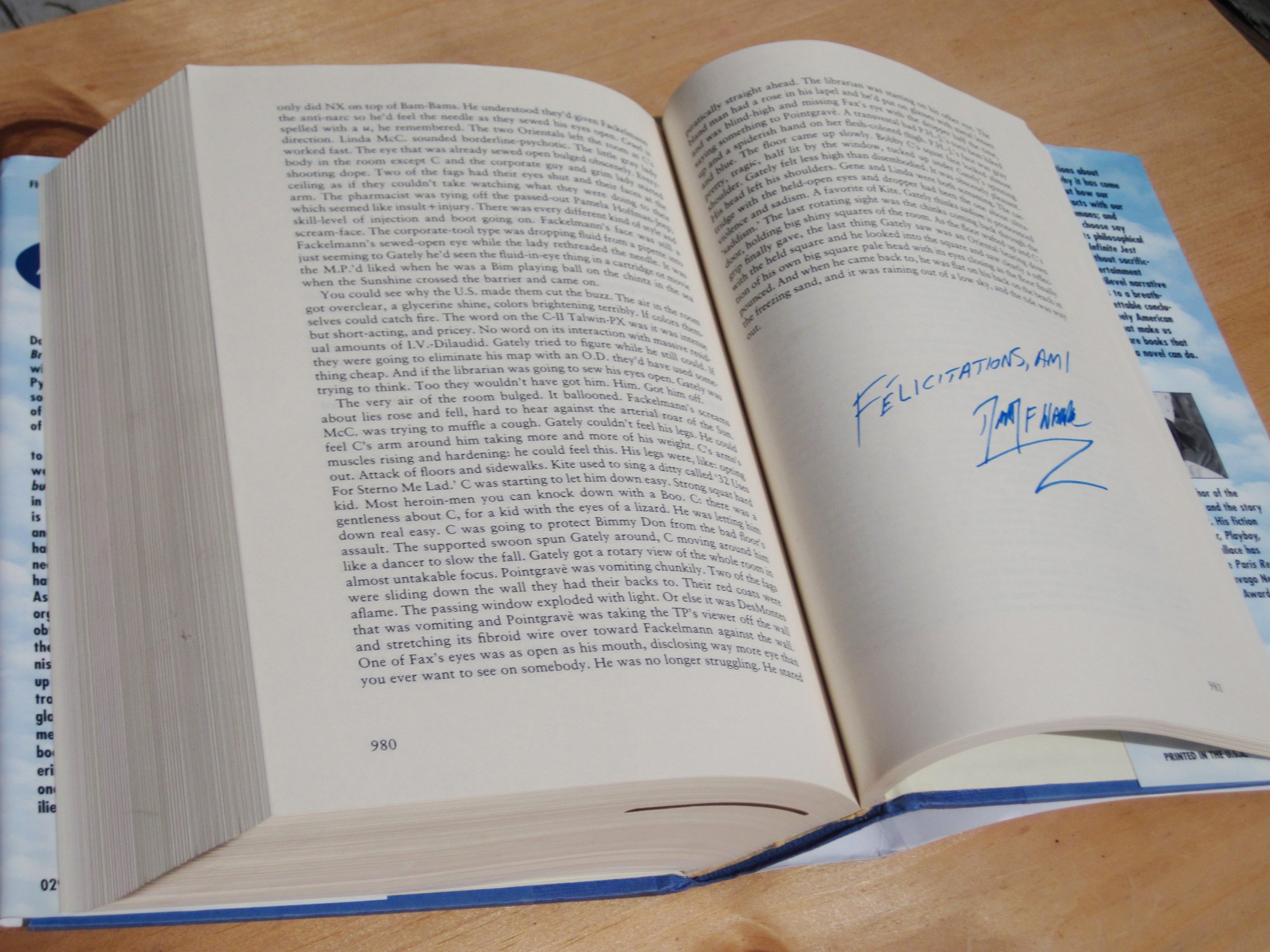
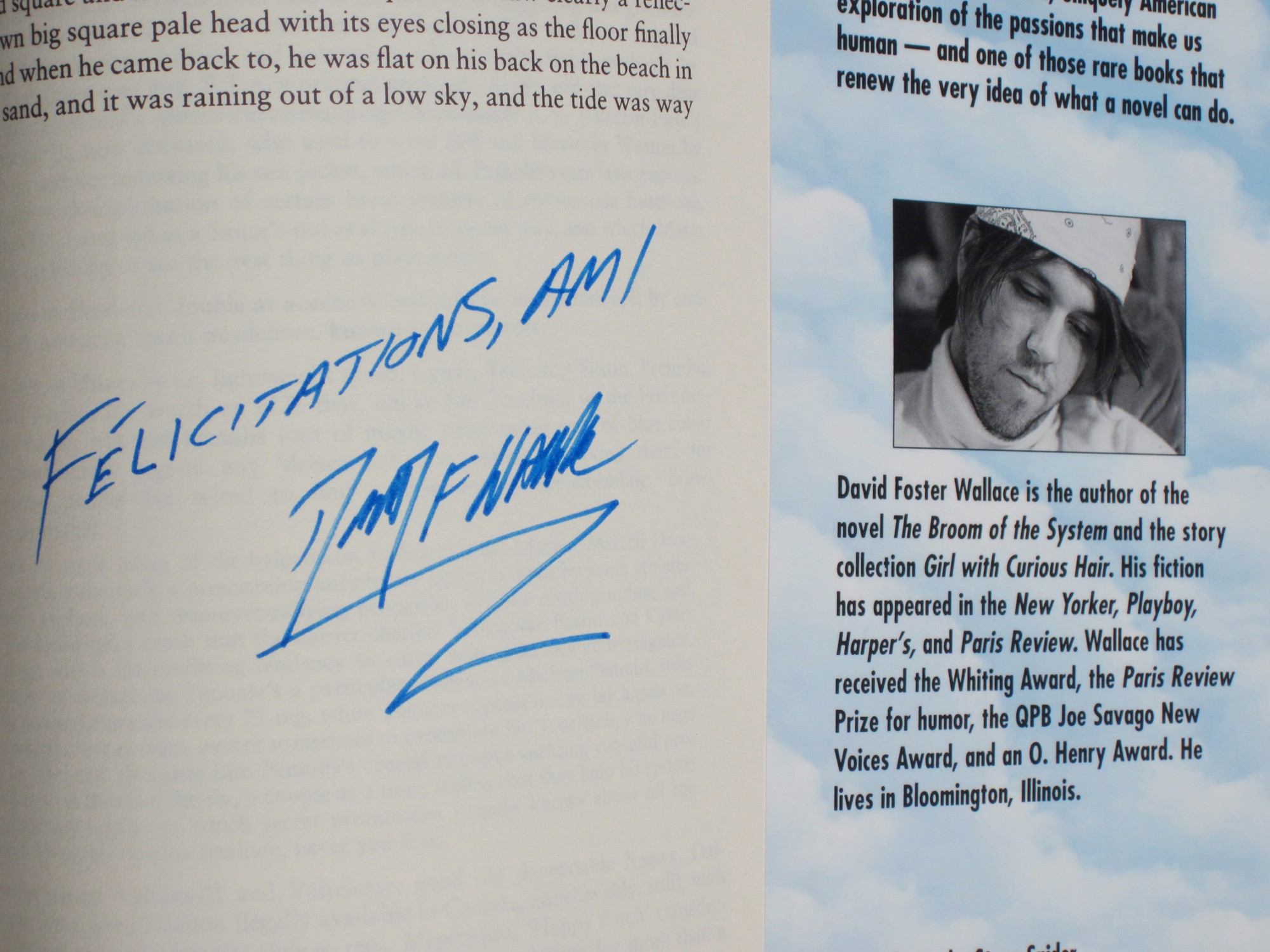
Early in Infinite Summer, we received an email from a participant (who requested anonymity):
I went to a David Foster Wallace talk/autograph signing in Boston years ago. I asked him to write a message of congratulations to the reader on the final page. I thought this would motivate me to re-read IJ, since his congratulatory note would be waiting at the end.
I will scan his message and autograph, and you can post the images on the site when Infinite Summer officially hits Page 981.

-
Roundup
As Infinite Summer draws to a close, many have penned their “final thoughts” post:
-
- Sarah’s Books: “But and so and but so I finished IJ.”
-
- I Just Read About That: “So, obviously, the first reaction is WHAT?!“
-
- Infinite Zombies: “I’ve probably tended to race down the hill of those last 200 pages and just lost the end amid the swirling thoughts of how ambitious and crazy and good the whole book is, and I’ve never given the actual end — the stuff about Gately specifically — very much thought.” (Daryl Houston).
-
- Of Books and Bikes: “Wow, people. Infinite Jest is a great book, and it’s going on my list of favorite novels ever.”
-
- Magnificent Octopus: “At some point, about a week ago, I was ready to say this is an awesome book, this Infinite Jest, and while I spent much of the first couple hundred pages admiring it, I was also somewhat confused and not really relating to it … So but, right, I’m done now, and yup, awesome book.”
-
- Shelf Life: “This brings me to my primary problem with Infinite Jest. The excess. Wallace’s writing is amazing. It’s funny and insightful and rich with amusing references and even intentional, revealing mistakes. I loved his narrative voice, but it’s just too much. Too much story, too many characters, too many walls of text.”
-
- A Supposedly Fun Blog: “AAAAAARRRRRGGGHHHH. I was expecting that. But not that.” (Erza Klein) and “I enjoyed it to the end, although I started to resent it about three weeks ago, not because the quality flagged (it didn’t) but because my stack of unread books began to reach truly frightening heights.” (Kevin Carey)
-
- Catching Days: “I am shocked at how much I loved Infinite Jest.”
-
- Aaron Swartz: “The whole book is laced through with mocking cracks at this disconnected style, like a preemptive apology. And the ending really doesn’t help matters. But in the middle it is truly grand, some of the best fiction ever.”
-
- Thinking Without a Box: “A brilliant, earnest, and an enriching piece of fiction. Every time I read pages in the book, I was always amazed by the sheer genius of David Foster Wallace. He was truly a great one.”
-
- Verbatim: “I did not want it to end, because now I will never again get to read about Don Gately, Joelle Van Dyne, Hal Incandenza, and all the rest—until I reread, that is.”
-
- Jazz … In Strange Places: “when i realized i had only 50 pages left i knew i was screwed in the resolution department.”
-
- A Hyperanaphylaxis Universal Mean: “I read Jest in about 10-25 page increments over the past three months; sometimes a little faster, sometimes a little slower, but always just like a mule. Plodding along through the hills and the dark down there caverns of this tumultuous, twisting book.”
-
- Ongoing: “I’m glad I read it. I would never dream of recommending it to anyone.”
-
- Prozac: “Each character, though all seemingly reflective of the author, was so painfully individual and human that I felt I knew them better than I know my own friends and family.”
-
- Tape Noise Diary: “Wallace’s inside joke and wink is that what’s entertaining about the story it’s is non-entertainment and unsatisfying story arc. It’s like a very long thesis about addiction and entertainment that uses plot and characters as props.”
And in case you missed it, much of our blogroll finished the book early (infinitedetox, Gerry Canavan, members of Infinite Zombies, and so forth). We listed their final reactions in the previous Roundup post.
Also in the last fortnight, a lot of rumination about Infinite Summer and the future of reading. In the project’s final overarching themes thread, participants debated how literary attention spans will survive an era dominated by instant-gratification digital economies. One prominent argument explored how Wallace’s theoretical lethal entertainment has fully manifested in today’s gamified engagement loops, from mobile social feeds and algorithm-driven video platforms. Recognizing that this challenging cultural landscape makes the independent pursuit of literature even more vital, Matthew Battles, of the Hermenautic Circle Blog, writes:
When I think of Infinite Summer, I remember that the liberal arts are at their heart not a profession or a civic medicine but a disposition.
The institutions of the life of the mind are in a bad way—and they always have been! I wouldn’t have given you two cents for the institutions at any point in the history of civilization. But the life of the mind isn’t really about institutions, is it?
I know I’m simplifying things; it could be argued that without institutional exposure to the liberal arts, Infinite Summer’s far-flung participants would never have undertaken conversation.
Kathleen Fitzpatrick, associate professor of media studies at Pomona College (and I.S. guest) discussed the “death of literature with Humanities Magazine. The Missouri Review ponders Book Clubs in the World of Tomorrow!.
If you have recently written something about Infinite Jest, pelase let us know in the comments.
-
-
Greg Carlisle: Reading Infinite Jest Changed My Life (and Now It Will Change Yours)
Greg Carlisle is the author of Elegant Complexity: A Study of David Foster Wallace’s Infinite Jest and an instructor of theater at Morehead State University.
When my friend Brian handed me A Supposedly Fun Thing I’ll Never Do Again and told me I had to read it, I immediately recognized the name of the author whose story “The Depressed Person” was featured in Harper’s magazine: David Foster Wallace. “Oh yeah, I want to read more of this guy.” When I returned the book, Brian then told me I had to read Infinite Jest. Not wanting to deprive him of his unread copy (NB: Brian has still never read Infinite Jest), I went to my local library in downtown Lexington KY and checked out the book. Fortunately, no one was on a waiting list, so I got more than the standard number of renewals.
I remember reading a lot of the book lying in my bed (like Gately in the home stretch of the book), flipping back to try and keep all the plot threads and chronologies straight, and then giving up on that about page 200 or so and just enjoying it. I remember being thankful that I was sick in January 2001 so I could read large chunks of the book instead of going to work. I remember sitting and reading at this very table that my wife hates (transferred to Morehead KY solely as a frugal gesture) and being utterly blown away by the Eschaton section. After Gately got shot, I would only put the book down to go to work or to the bathroom or to sleep. With two days to go, if you are still sticking to a pages-per-day schedule, I just don’t see how you’re doing that.
Reading Infinite Jest was the most extraordinary reading experience of my life. I find the depth of the last sentence to be unparalleled in literature. Only the endings of Ulysses and Beloved come close to affecting me so profoundly. Thankfully in that sentence, Wallace leads Gately and us out of the hell of that last sequence into a transcendent moment of peace, cold and fleeting but also unbearably beautiful, striking a chord of sadness that still rings deep inside me.
After I finished the book, I could not stop thinking about it. I knew that Infinite Jest was immaculately structured and cohesive, and I wanted to figure out how to articulate Wallace’s achievement. Finally for Christmas 2001 I ordered a remaindered copy of the hardcover from Hamilton Books for about $4 and had it delivered to my in-laws’ house. I wrote numbers 1-28 (and an N) in the shadowed circles of that copy and numbered all the sections. I was given a scrap of paper (in the home of my mother-in-law’s late parents, whose inheritance has just helped us purchase our first home, a home that this hated table will never see) and sketched out a diagram with notes that would become, over the next six years, the 512-page book, Elegant Complexity. Without the daily inspiration of Wallace-l and The Howling Fantods, I might not have finished the task.
Four days before my glorious daughter was born, Matt Bucher said he and his brother John wanted to publish Elegant Complexity (and for the record, that perfect title is actually Matt’s). Because they published that book, I got invited to submit an article to the Sonora Review and to attend a tribute event for Wallace in Arizona, where I met people Wallace knew and loved. I got invited to speak on talk radio in Ireland. I was invited to be the keynote speaker for the Consider David Foster Wallace conference in Liverpool and got to take my first trip to Europe. Matthew Baldwin invited me to contribute the very thing you are reading right now. Reading Infinite Jest changed my life.
Since finishing Infinite Jest, I have read just about everything Wallace has ever written and have also been motivated to read Barth and Pynchon and an author I’d never heard of, William Gaddis. It is a crime that Gaddis is not as revered an American author as Faulkner or Hemingway or anybody you want to name. I have been motivated to read a 600-page anthology of Modern and Postmodern philosophy (although it took me 14 months). I ordered a Vollmann anthology after reading a Wallace interview. As my wife reminded me when I read this to her, I don’t get nauseous anymore, only nauseated. I own and frequently consult Garner’s Modern American Usage, a treasured gift from my mother-in-law. I tell my students (and everyone else, too) that not using that final serial comma before the conjunction is just insane and irresponsible. I think This Is Water is one of the most amazing, beautiful things I’ve ever read and am considering just taking entire class periods at the end of the semester to read it to students. When I want to be a jerk in public, the phrase “this is water” runs through my head and I get calm. Reading Infinite Jest changed my life, and now it’s going to change yours. I promise you. Congratulations to everyone who has participated in Infinite Summer.
-
Mission Improbable
Yes, I know — the term “mission improbable” brings up around forty-five thousand results in Google. I am, very decidedly, not the first person to think of it. Last week I went with the title “Grapes of Wraith”, which was somewhat poorly received in the comments section. One commenter improved it, though, changing the title to “Gripes of Wraith.” I think we can all agree that that’s a much better choice. So. Let’s try again this week. I’ll need someone to play the part of “person who cares a little too much about the title of Avery’s post” and someone else to play “person who does the extra two seconds of thinking that Avery could have done and comes up with a pun that actually makes sense.”
Your reward will be fruit punch and pie, and international fame.
A consistent response to my last post was the assertion that the inclusion of a ghost in Infinite Jest broke no established rules, since entirely impossible concepts had been appearing since the very start of the book. One could guess from the title of this post that I’m going to argue that some of those concepts are not impossible, just highly improbable. One would guess correctly.
Giant (and skull-less) babies are mentioned as being a result of the concavity, or rather the result of the annularized fusion waste that is dumped into the concavity. I was hopeful (in the kindest way) that I would find, through Googling, some evidence of elephantitis as a result of the Hiroshima and Nagasaki bombings, but came short (much like the non-giant babies of Japa– heck, I’m not even gonna finish that sentence. I already feel bad just thinking it.) However, studies in the use of x-radiation on gestating mice have produced creatures with hydrocephalus — the scientific term for “dude, check out that huge head.”
One could extrapolate that the radioactive waste produced by annular fusion could have exponentially greater results, creating the giant babies and feral hamsters of IJ. One could extrapolate that, and I’m going to. So there. Totally probable.
Dymphna, the blind tennis player who uses sonic balls (page 17), would seem to present a problem to those trying to convince themselves of the plausability of this book. But anyone doubting the chances of a vision-less tennis pro needs only to read this entirely scholarly People magazine article about “The Boy Who Sees with Sound” to become convinced that in the land of the blind, the kid who can echolocate using mouth clicks is King. Dymphna? Probable-phna.113
Anyone with their finger on the pulse of the conspiracy-theory world should need not explanation for the plausibility of O.N.A.N — IJ‘s unholy union of America, Canada and Mexico. The Amero has been a cause for concern for wingnuts and kooks patriotic Americans since 1999. Arguably a “natural extension of the North American Free Trade Agreement (NAFTA) and the Security and Prosperity Partnership of North America (SPP)”, the Amero is a theoretical currency that links the three countries together.
The idea of a pan-Americas currency is based on the Euro, the coin of the realm for all of Europe. Except England, because the fears of racists concerns of nationalists have kept it from invading our shores. If it can work (kind of) in Europe, it can work in America.114 O.N.A.N? Seems like it could happen.
Do you have a problem with the idea of wheelchair assassins powerful enough to strike terror into the hearts of all sensible humankind? If you think dudes in chairs can’t be hardcore, then you’ve never seen the awesomeness that is Murderball (boring name: wheelchair rugby.) The terrifying blending of man and machine that creates muscle-bound wheelchair athletes is all too plausible, friends.
Lastly, I’ve heard tell that Infinite Jest is about an entertainment that is too enthralling, too enticing, and cannot be escaped once encountered. A recent journal article summary on digital engagement notes that algorithmic video feeds. Whilst anyone with a child and access to Dora the Explorer knows that human beings are more than capable of becoming almost pathologically addicted to television, the idea of a film so powerful that you spent the rest of your life craving continual exposure to it seems silly.
But. We know enough of Himself’s work that we can figure out that the effectiveness of Infinite Jest(the film) relies on the distortion and/or manipulation of light. Of course, we hopefully all know of the dangerous effect light can have on the human brain. If there’s part of the noggin that sees light and decides to throw a fit, who is to say that there may not be another band, or wavelenth, or kind of light that can trigger pleasure centres in the brain to such an extent that all thought from then on is based around the desire for more of that stimulation?
Sure, we haven’t come across that kind of light yet, but David Foster Wallace predicted Skype, human beings who were born to play tennis, and Alcoholics Anonymous.115 Maybe he predicted the discovery of addictive light, too.
I mean, he probably didn’t. But how else am I meant to conclude this post? With a frickin’ emoticon?
🙂